Ferrari Hypersail brings Maranello tech to offshore racing
Published Date :
Ferrari’s 100-foot Hypersail uses advanced energy management, Winch-by-Wire and renewable harvesting to target full energy autonomy at sea.
Ferrari has revealed the onboard energy concept for Hypersail, its 100-foot flying monohull designed to push the boundaries of offshore racing through advanced engineering and energy autonomy. The project extends Ferrari’s technical expertise beyond road cars and motorsport, applying Maranello-developed technologies to one of the most demanding environments in competitive sailing.
Energy autonomy from Maranello
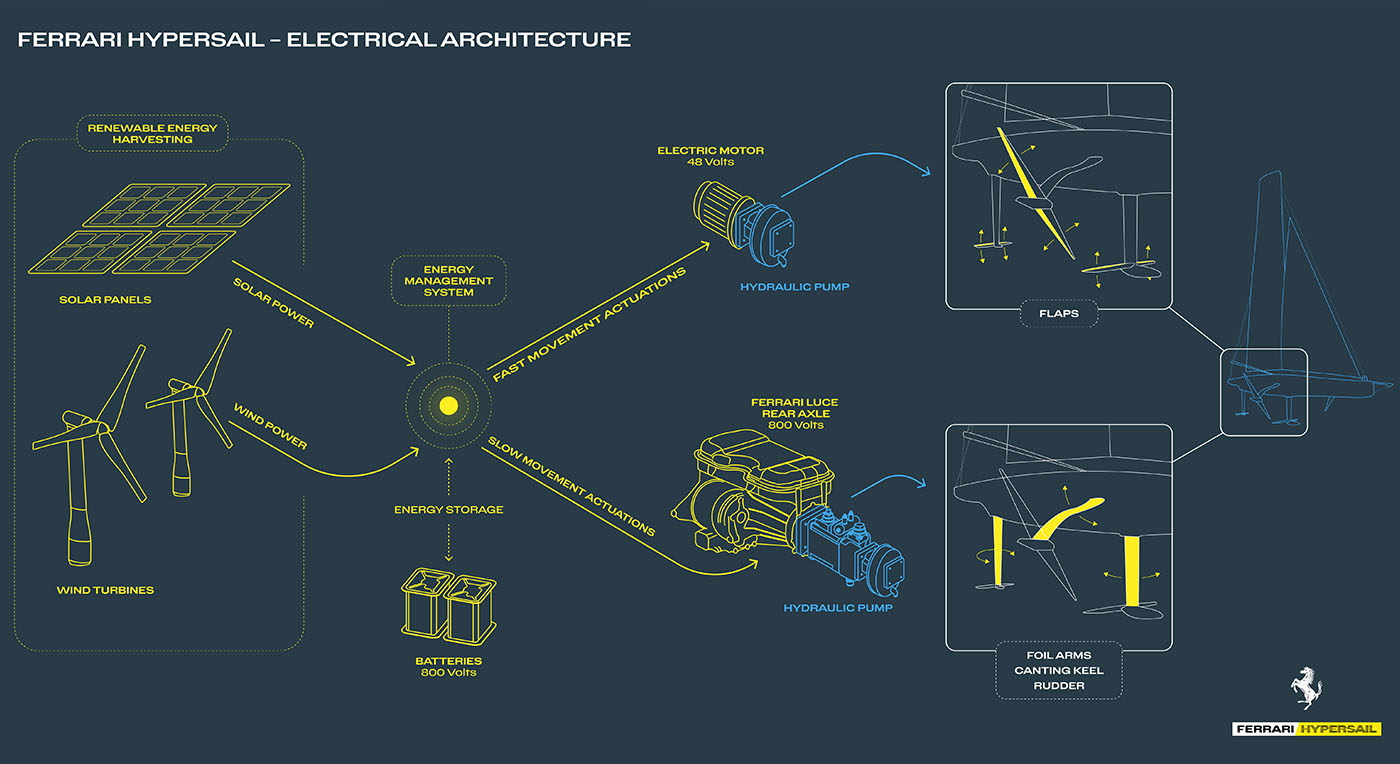
Developed by the Hypersail Tech Team in Maranello, the vessel’s Energy Management system is designed to maximise efficiency while integrating all onboard systems into a single intelligent architecture.
Ferrari says the electric system enables full energy self-sufficiency during long-distance sailing by harvesting power from renewable sources such as solar and wind, while also converting crew-generated effort into usable electricity.
Marco Guglielmo Ribigini, Technical Team Leader of Ferrari Hypersail, said the system balances performance and efficiency, with technologies like Winch-by-Wire ensuring energy generated onboard is continuously reused.
Winch-by-Wire above deck
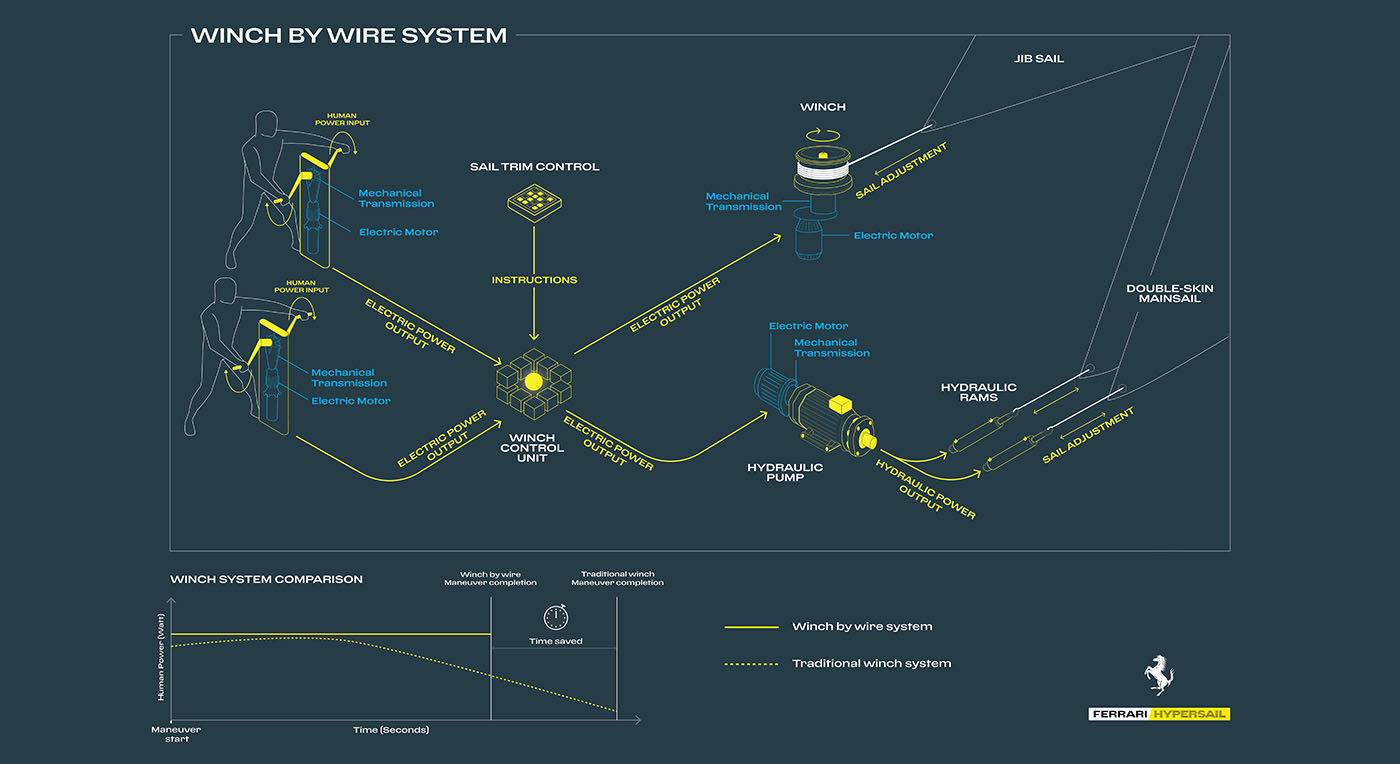
Above deck, Hypersail introduces a Winch-by-Wire system that transforms how sail trimming is managed.
Instead of directly powering mechanical or hydraulic systems, crew input is converted into electrical energy, centralised and redistributed across the vessel. This allows more consistent effort from crew members while maintaining optimal efficiency.
Ferrari says the system enables a single crew member to control loads of up to 9 tonnes, exceeding the limits of conventional setups.
Ferrari components on board
The system uses electric motors derived from Ferrari road cars, including components found in models such as the Ferrari Purosangue and the Ferrari F80.
Generated energy is distributed in real time to power sail control systems and onboard hydraulic functions, following the same by-wire philosophy used in Ferrari’s latest performance vehicles.
Flight control below deck
Below deck, Hypersail integrates advanced control systems to manage stability, ride height and foil operation.
A network of electronic control units and sensors operates across multiple voltage levels, from 12V to 800V, ensuring reliability and redundancy. An active Flight Controller manages hydraulic systems through two modes: Slow Movements for structural adjustments and Fast Movements for real-time control inputs.
Renewable energy systems
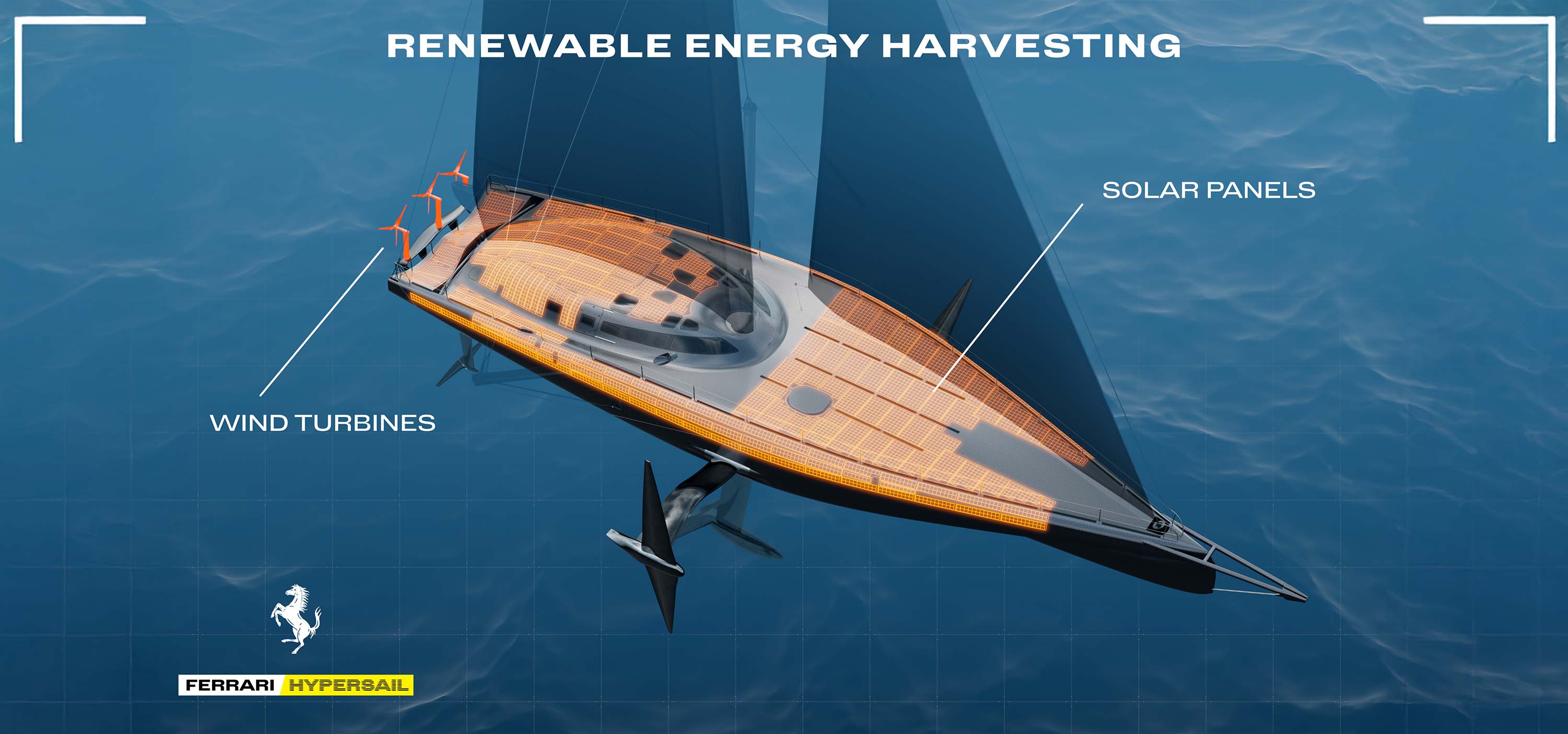
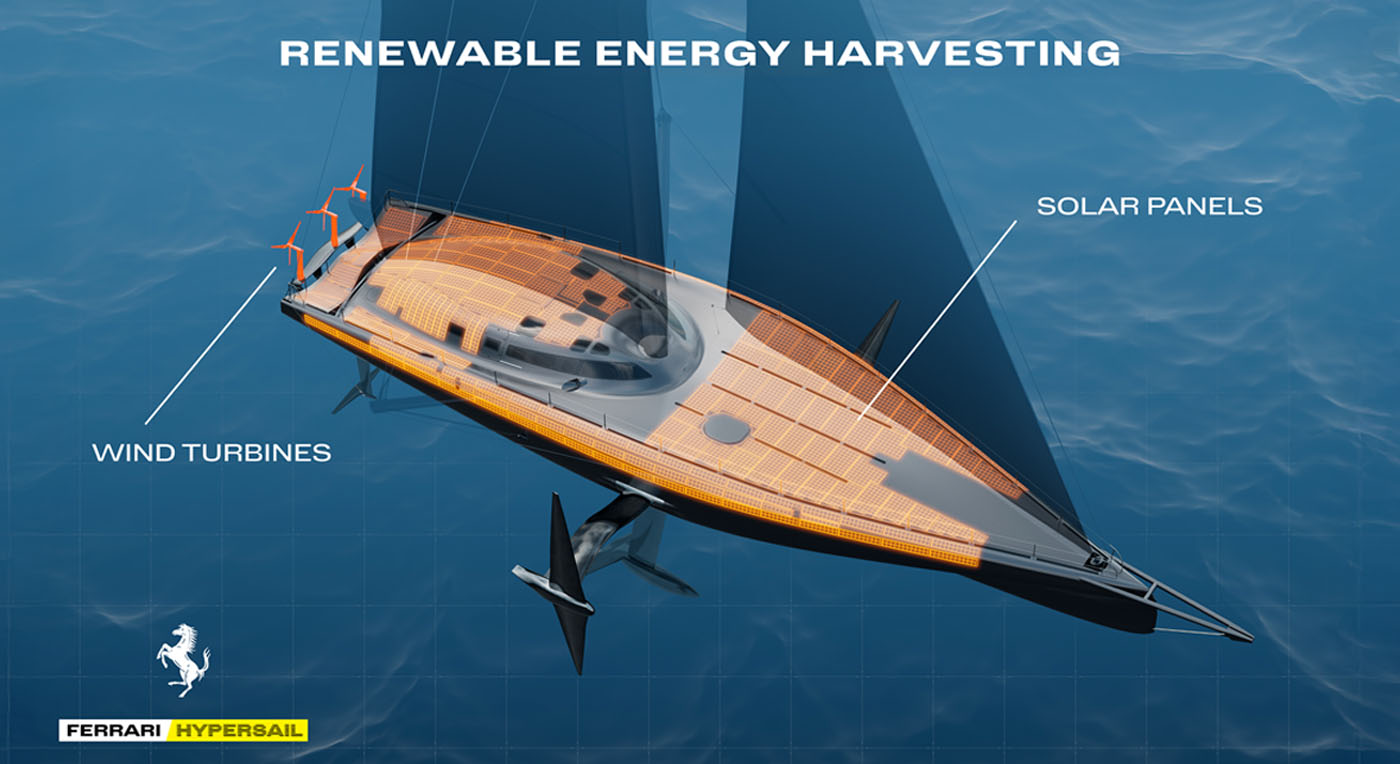
All onboard systems are powered exclusively through renewable energy sources. Solar panels integrated into the deck and topsides cover approximately 100 square metres, designed to maximise energy capture while maintaining performance efficiency.
Wind turbines mounted at the stern further support energy generation, with configurations adaptable to different sailing conditions.
Surplus energy is stored in dual 800V battery systems, ensuring consistent power availability across changing operational demands.
A floating technology lab
Ferrari describes Hypersail as a technology platform that brings together energy recovery, by-wire systems, high-voltage architecture and lightweight engineering.
While not a road vehicle, the project reflects Ferrari’s broader innovation strategy, demonstrating how its engineering expertise can be applied beyond traditional automotive applications.
For Ferrari, Hypersail represents a new frontier, a floating laboratory designed to explore how energy can be generated, managed and deployed in extreme real-world conditions.




Loading comments...