
2026 Alfa Romeo Giulia Quadrifoglio Review
This four-door race car for the road pairs a 510 PS twin-turbo V6 with razor-sharp handling and unmistakable Italian character, though age and practicality aren’t its strongest suits
When you’re looking for a performance car, you’re usually looking for more than just speed. You often want power, a sonorous exhaust note to rattle your eardrums, and, of course, prestige and a legacy — something built for both the road and the track. Very few cars manage to tick all those boxes, and even fewer get the balance right. For many, the Porsche 911 defines perfection; for others, there are few equals to the BMW M3 and M4 siblings. But for a smaller community of mostly expat European enthusiasts, the Alfa Romeo Giulia Quadrifoglio is one of those cars. It has a name that is about as Italian as it gets and a fan base made up of hopeless automotive romantics. Then there’s its Ferrari-linked twin-turbo V6, wrapped in unmistakably Italian styling — a combination that sounds like the stuff of daydreams. But with a starting price of AED 419,900, the Giulia Quadrifoglio also delivers a fairly sharp wake-up call to reality. Here’s what we thought after spending a few days with this four-door sports car.
History
The Quadrifoglio emblem dates back to 1923, when racing driver Ugo Sivocci entered the Targa Florio in an Alfa Romeo RL carrying a green four-leaf clover on a white diamond. Sivocci won the race, turning the symbol into a good-luck charm for Alfa Romeo. Just months later, he was killed while testing a car that, by coincidence, did not carry the emblem, further cementing its place in the brand’s motorsport identity.
The Quadrifoglio later appeared through some of Alfa Romeo’s greatest racing successes, including the first World Championship for Grand Prix cars in 1925 and the first two Formula 1 World Championships in 1950 and 1951.
Its centenary was marked in 2023 with dedicated 100° Anniversario models and a special logo. Alfa Romeo has also tied the badge to other historic victories, including the 6C 1500 “Super Sport”, winner of the 1000 Miglia in 1928 and later honoured by the Giulia and Stelvio Quadrifoglio Super Sport editions.
The Giulia Quadrifoglio itself was revealed in 2015 and launched in 2016, marking Alfa Romeo’s return to the rear-wheel-drive sports-sedan formula after the Alfa 75.
Exterior design
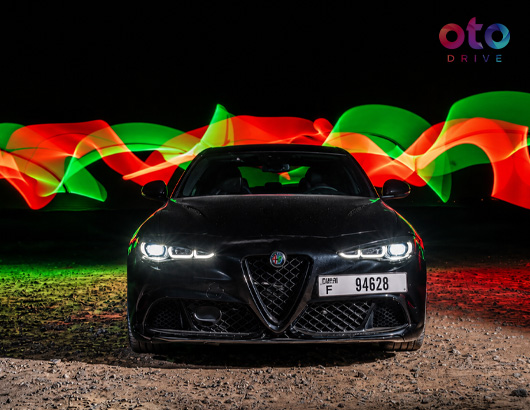
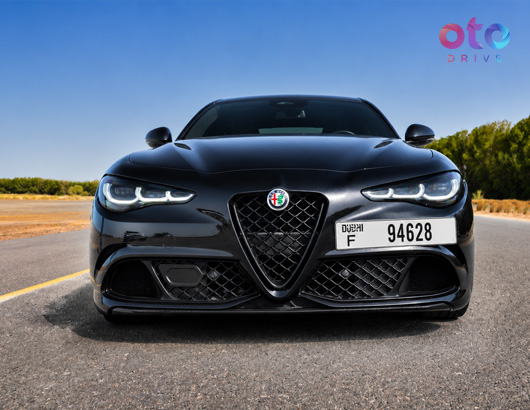
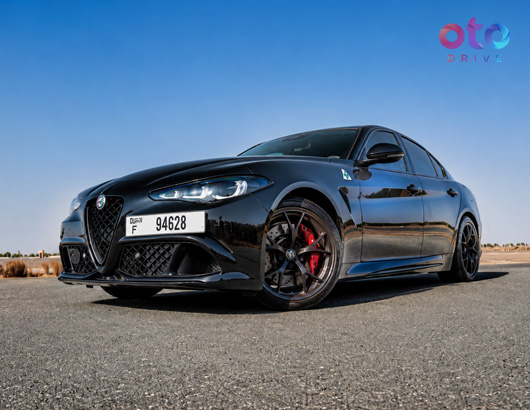
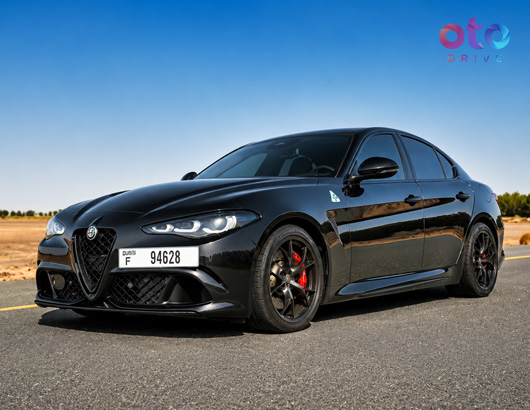
The Alfa Romeo Giulia has an understated sense of style. It doesn’t scream “look at me”; instead, it is elegant and restrained, with enough quirks to give it that unmistakable Italian flavour.
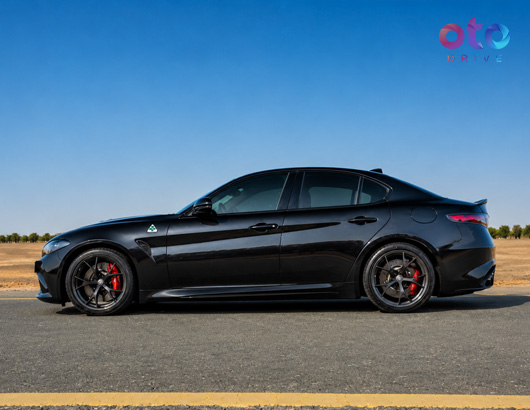
The Giulia is also relatively compact, measuring 4,639 mm long, 1,873 mm wide without the mirrors, 2,024 mm with them, and 1,433 mm tall. From behind the wheel, it genuinely feels like a compact car.
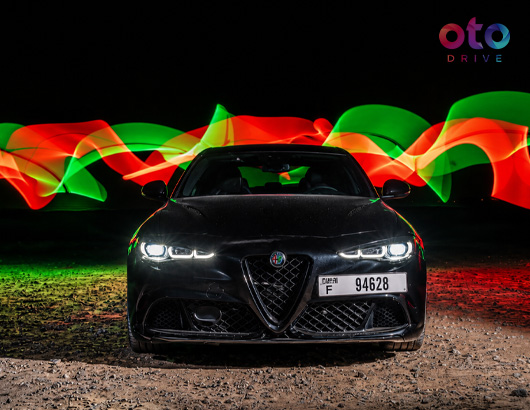
Up front, its alluring face is defined by headlamp clusters pulled towards the outer edges and incorporating Alfa Romeo’s distinctive Full-LED adaptive Matrix 3+3 headlights. The familiar triangular V-shield within the trilobe grille gets a dark Miron finish.
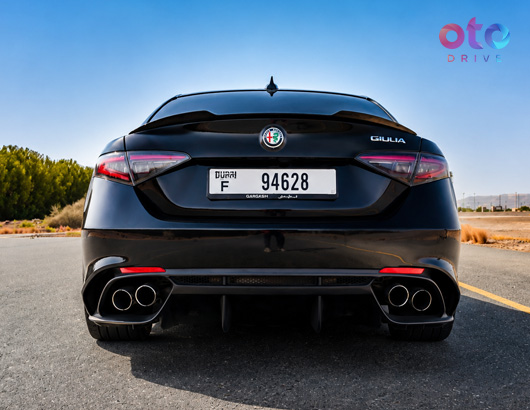
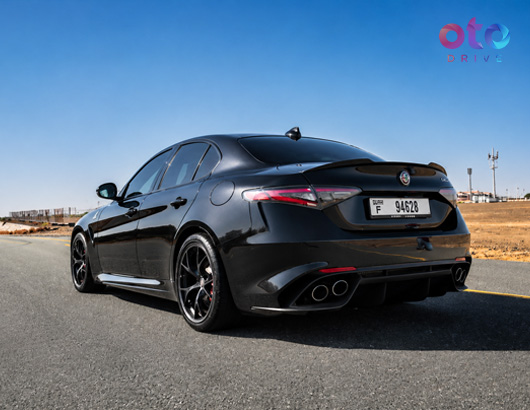
At the rear, the LED-lit lamps look comparatively ordinary and almost Civic-like, but the large quad exhaust outlets clearly convey both the car’s sporting intentions and its evocative soundtrack.
There is plenty of carbon fibre, both to save weight and underline the Quadrifoglio’s racing DNA. It gets a carbon-fibre roof and rear spoiler, along with a properly substantial rear diffuser rather than a decorative one. The downside is that the active carbon-fibre front splitter sits very low and can scrape over speed bumps or parking wheel stoppers.
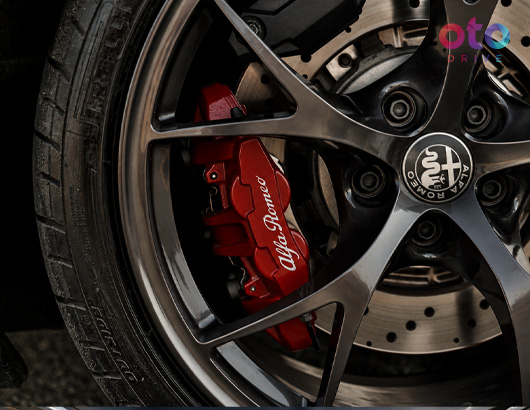
I also like how the 19-inch black Alfa Romeo alloy wheels use slim, motorsport-inspired spokes that expose the brakes and red calipers behind them. They fill the arches well and sit nicely flush with the body.
And finally, the black paintwork gives the Giulia Quadrifoglio a discreet, mysterious character, almost like it belongs to an owner who enjoys the finer pleasures in life but prefers to keep them private.
Interior design
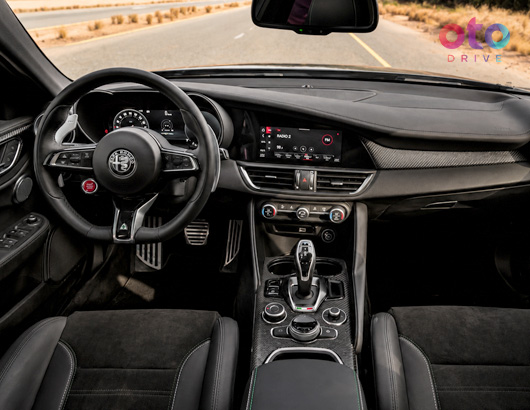
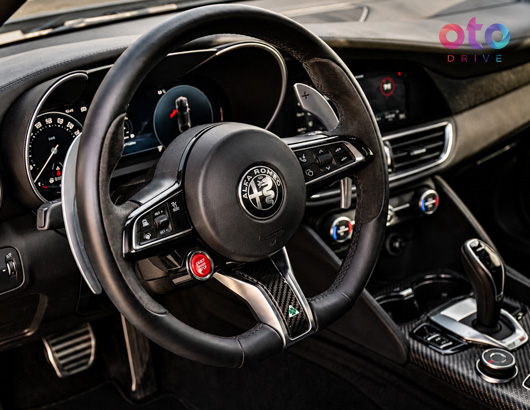
The Giulia has a quaint, contemporary-chic cabin that relies more on familiarity. It is richly finished with black leather and plastics, with satin trim to spruce things up. I also love the exposed carbon-fibre weave that runs across the doors and dashboard. It is not as screen-heavy or spaceship-like as many newer interiors, but that also means it is beginning to show its age.
The focal point is the chunky three-spoke steering wheel, wrapped in leather and Alcantara. It features a bright red starter button. The steering-wheel controls are large, easy to read and simple to operate, while the large fixed aluminium paddle shifters are easy to find while steering.
The driving position is excellent too. You sit relatively low, with good overall visibility, and feel properly connected to the car.
Ahead of the driver is a 12.3-inch digital instrument cluster with configurable layouts, housed within Alfa Romeo’s traditional tunnelled ‘Cannocchiale’ binnacle. Interestingly, the speed markings progressively appear as the needle swings around the dial.
The toggling BMW-style transmission controller looks good, but the overall operation does not feel particularly positive.
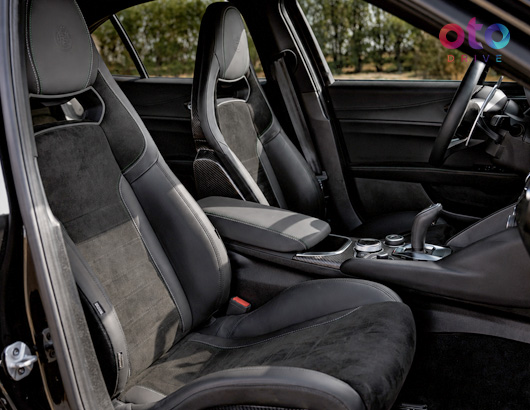
The optional Sparco carbon-shell sports seats look fantastic, upholstered in leather and Alcantara with white and green contrast stitching. They provide serious lateral support, but there is not much padding. If you do not regularly track your car, I would choose the regular seats.
Adjustment is also limited, and on our test car the passenger-side seat-control switch fell off, signalling some build-quality concerns.
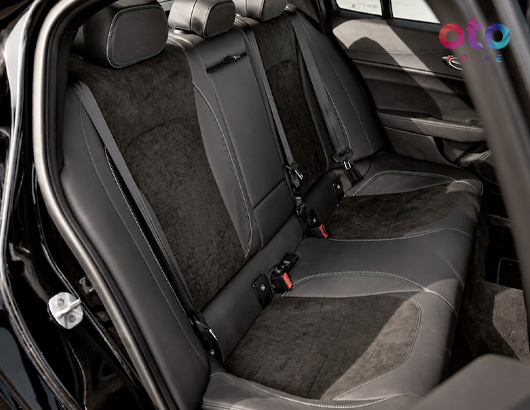
Rear-seat headroom is good, but there is only around an inch of knee room for a six-footer. It is also really meant for just two adults, while ingress and egress can be difficult because of the relatively small rear door opening.
Features and functionality
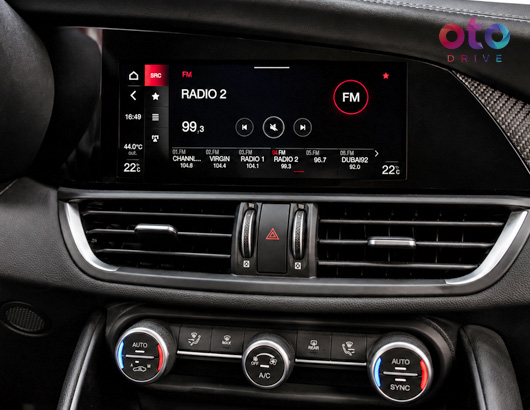
The infotainment screen measures 8.8 inches, adequate a decade ago, but small by 2026 standards. It can be operated through either the touchscreen or rotary controller and supports Apple CarPlay and Android Auto.
The Giulia also comes with a 900-watt Harman Kardon audio system with 14 speakers, including a subwoofer. Sound quality is good, though not a standout feature.
Connectivity is fairly comprehensive, with USB-A, USB-C and AUX ports, along with a slanted wireless charging pad. The presence of USB-A again gives away the age of the design.
Strangely, at this price point, the Giulia does not have a 360-degree surround-view camera. Instead, you get front and rear parking sensors and a rear-view camera. According to our video tester, there were also some infotainment glitches. The screen occasionally switched off while adjusting the volume, while the Bluetooth connection to the phone would sometimes cut out.
Storage is limited. The door bins are very small, while the two decent-sized cupholders can partially obstruct the climate controls. There is also a little extra space for smaller items on the lower centre console.
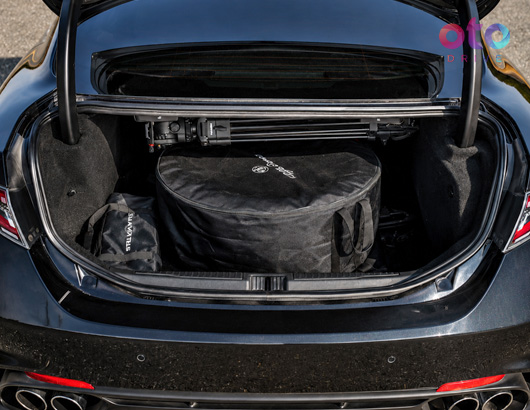
Boot capacity is officially quoted at a respectable 480 litres. However, the full-size spare wheel leaves room for roughly one large suitcase.
The air-conditioning works well enough. At no point did it feel like it was struggling with the UAE’s intense summer heat, although our video reviewer did complain about it. Rear passengers also get circular air vents.
Overall, the Giulia is not the most practical or luxurious car despite being a traditional four-door sedan. Its strengths lie elsewhere.
Powertrain, performance and fuel economy
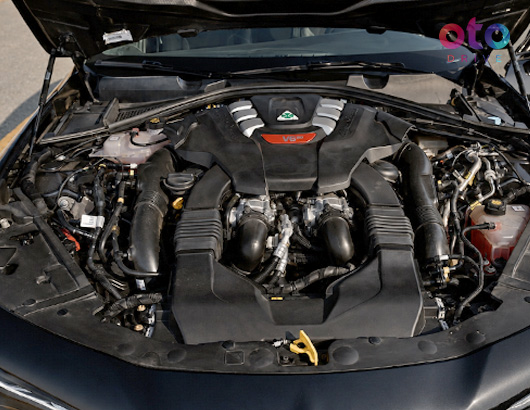
Befitting its sporting credentials is a 2.9-litre twin-turbo V6. Some call it a Ferrari engine with two cylinders removed, although that would be an oversimplification.
It produces a purposeful 510 PS at 6,500 rpm and a wholesome 600 Nm from 2,500 to 5,000 rpm, paired with an eight-speed automatic transmission and a carbon-fibre driveshaft weighing just 7 kg, sending power to the rear wheels like a good old-fashioned sports car.
It is also a surprisingly refined engine, with smooth power delivery, although there is a little turbo lag lower down. From around 3,000 rpm, the V6 really starts to come alive, pulling strongly towards 7,000 rpm. The soundtrack follows suit, going from a subdued burble to a noticeably raspier note. The downside is that you need to rev it out to get the full experience, so everyday driving is not always as exciting.
The best 0–100 km/h time we managed was 4.4 seconds, a little off Alfa Romeo’s official 3.9-second claim, but still rapid. Then there are the cast-iron brakes, and they are excellent. The Giulia can seemingly stop on a dime, doubling down on its sports-car identity.
You can switch between Alfa Romeo’s interestingly named DNA drive modes: Dynamic, Natural and Advanced Efficiency, while Race mode can cut shift times to just 150 milliseconds.
Advanced Efficiency is designed to maximise fuel economy by deactivating three cylinders, although it doesn’t seem to help fuel economy much. The worst figure we saw was around 20 L/100 km, while our best average was approximately 8.5 L/100 km. Combine that with the modest 58-litre fuel tank, and you may find yourself frequenting petrol stations.
Ride and handling
The Quadrifoglio also uses an Alfa Active Aero Splitter, a moving carbon-fibre element integrated into the lower front fascia. It automatically adjusts to improve aerodynamics and downforce, helping optimise grip and stability. Alfa Romeo describes the Giulia as the only sedan in the world with active aerodynamics.
The suspension does an excellent job of keeping the car controlled. The chassis combines a double-wishbone front suspension with Alfa’s rear multi-link arrangement, while Alfa Active Suspension uses adaptive dampers to vary the damping according to the driving mode and conditions. Its 50:50 weight distribution further contributes to that sense of balance.
The Giulia Quadrifoglio also has some of the sharpest steering you will find in a passenger car. The response is quick and accurate, to the point that it can make something like a Golf GTI feel comparatively lacking. There is also Alfa Active Torque Vectoring, which uses two electronically controlled mechanical clutches to distribute torque between the rear half-axles, helping improve traction and control across different road surfaces and at higher speeds.
Yet despite all that performance hardware, the ride remains surprisingly compliant and connected. The adaptive dampers help it feel sporty and controlled without constantly sending every rough-road vibration up your spine.
Safety ratings and features
The Giulia Quadrifoglio comes with a useful suite of driver-assistance systems, including Lane Keeping Assist, Active Blind Spot Assist, Intelligent Speed Control and Driver Attention Assist, while Alfa Romeo also describes the car as offering Level 2 assisted driving capability.
Other systems include Forward Collision Warning with Autonomous Emergency Braking, Traffic Sign Recognition, Active Cruise Control, Traffic Jam and Highway Assist, and Automatic High Beam.
The Giulia earned a five-star Euro NCAP rating in 2016, scoring 98 per cent for adult-occupant protection, 81 per cent for child-occupant protection and 69 per cent for pedestrian protection. However, that rating has since expired, and the current Giulia has not been reassessed under Euro NCAP’s latest testing protocols.
Verdict
The 2026 Alfa Romeo Giulia Quadrifoglio is a car that is almost as much about the experience of owning it as it is about driving it, parking it and admiring those sculpted lines, chatting with fellow Alfa enthusiasts at a meet, or finding the right road, carving through corners and pushing that V6 towards the redline. For everything in between, though, it is not the easiest performance sedan to live with.
Spend enough time with it and the rewards are obvious: razor-sharp steering, excellent balance, strong brakes and a 510 PS twin-turbo V6 with real character. It feels special even before you start moving, with distinctive styling, plenty of carbon fibre and compact dimensions that make it feel agile and easy to place.
There are compromises. The cabin is beginning to show its age, the 8.8-inch infotainment screen feels small by 2026 standards, practicality is only average, there is no 360-degree camera, and the optional hard-shell Sparco seats would not be my first choice for everyday use. We also experienced some minor build-quality and infotainment issues.
Then there is the AED 419,900 starting price…a serious amount of money! But for buyers who value heritage, character and driving involvement over outright practicality or the latest technology, the Giulia Quadrifoglio remains one of the most memorable performance sedans on sale.
Rivals and alternatives
The BMW M3 remains the Giulia Quadrifoglio’s most obvious rival, combining devastating pace with everyday usability, while the Mercedes-AMG C43 offers a more technology-led take on the compact performance sedan. The Audi RS4 Avant adds all-weather quattro traction and genuine estate practicality, while the Infiniti Q50 Red Sport 400, where available, remains an appealing value-focused alternative with a potent twin-turbo V6.
The Cadillac CT4-V Blackwing is another compelling choice, particularly for its sharp chassis and available manual gearbox, while the Lexus IS 500 counters with old-school naturally aspirated V8 character. Buyers willing to trade four-door practicality for a 2+2 performance car could also consider the Ford Mustang Dark Horse, with its muscular V8 and rear-wheel-drive attitude, or a Dodge Charger SRT for even more straight-line drama. The BMW M4 is another natural coupe alternative, combining much of the M3’s performance with a more overtly sporting shape.
Pros & Cons
Pros
- Italian styling
- Turbo power
- Sonorous exhaust
- Razor-sharp handling
- Rare
Cons
- Pricey
- Average build quality
- Temperamental infotainment system
- Turbo lag
- Residual value
Subscribe to Newsletter
Get the latest car reviews, auto news, and exclusive stories straight to your inbox. Stay ahead in the automotive world with OTO Drive.