2026 Honda CR-V LX Review
The Honda CR-V combines seven-seat practicality, a 190 hp turbo engine, strong ride comfort and Honda Sensing, but faces a growing number of well-equipped rivals around its AED 104,900 starting price in the UAE
What three letters come to mind when you’re looking for a reliable family SUV? For many buyers, particularly in the GCC, the answer is CR-V. The Honda CR-V has built its reputation over three decades. Honda says the SUV surpassed 15 million global sales in August 2025, 30 years after its 1995 debut, while 403,768 units were sold in the US in 2025. J.D. Power also rated the 2025 Honda CR-V 83/100 for Quality & Reliability and 86/100 for resale, with the previous model year ranking joint-first among compact SUVs overall. But the family SUV market has changed. Chinese rivals now offer more power, larger screens, richer cabins and longer equipment lists, often for similar or less money. So does the 2026 Honda CR-V still justify its AED 104,900 starting price in the UAE with its traditional strengths of reliability, practicality and straightforward engineering? We tested the Honda CR-V LX to find out whether this seven-seat family SUV still makes a compelling case for UAE buyers…and their families.
Exterior design
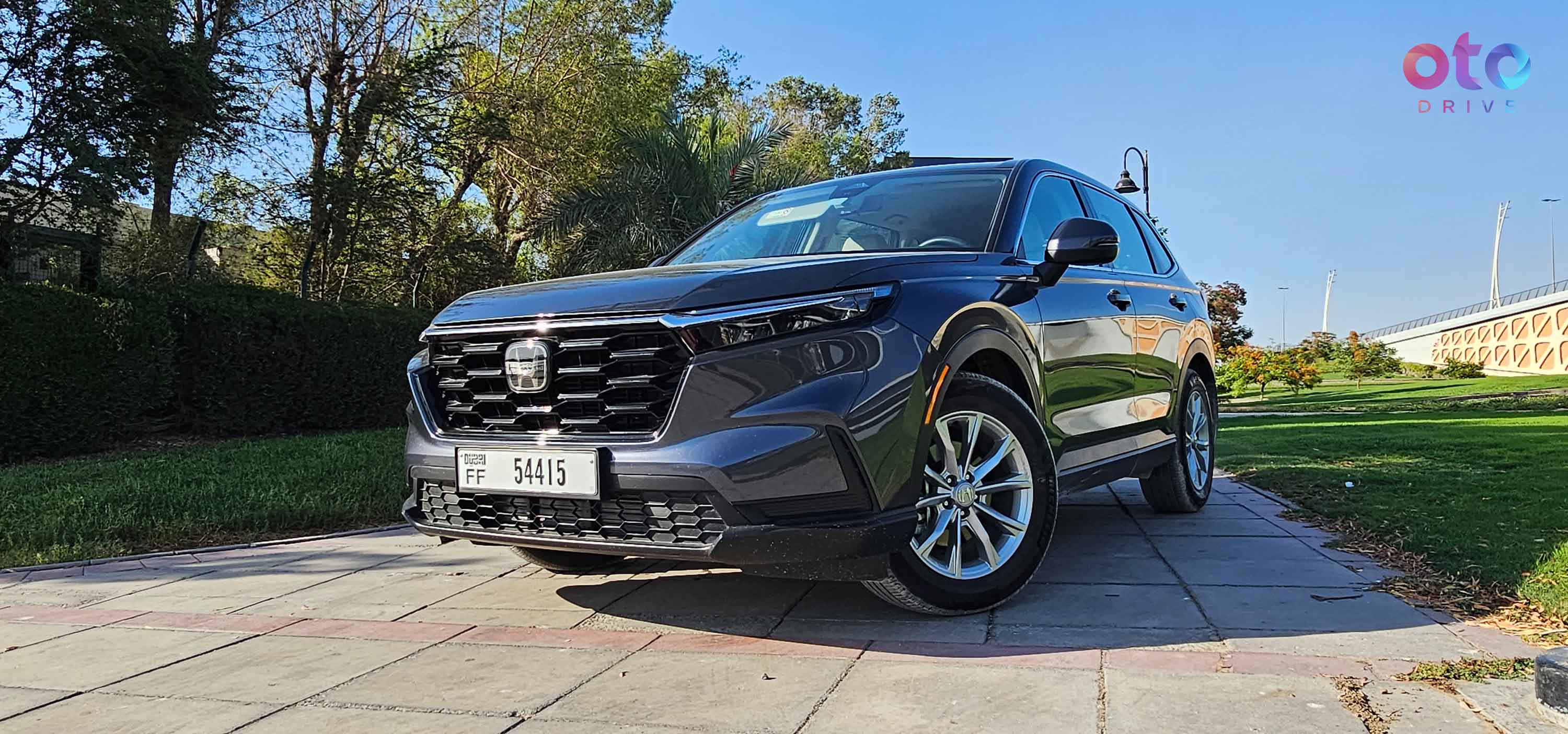
The sixth-generation Honda CR-V has come a long way from the cute, softly boxy SUV it once was. While the previous generation featured softer, more flowing surfaces, the 2026 Honda CR-V looks considerably more serious, with straighter lines, sharper edges and simpler styling cues.
Still classed as a compact SUV, the CR-V is a sizeable one. The Honda CR-V LX measures 4,706 mm long, 1,866 mm wide and 1,681 mm tall, making it longer and wider than arch-rivals such as the Toyota RAV4, Nissan X-Trail and Mazda CX-5.
Up front, a large black hexagonal-pattern grille is flanked by slim, swept-back full-LED headlights and a narrow chrome strip. This time around, the sides are cleaner, with flatter, less prominent wheel arches and relatively modest 18-inch multi-spoke alloy wheels. Chrome window surrounds add some brightness to the otherwise restrained profile.
At the rear, the latest Honda CR-V retains clear links to its predecessor. The tall, vertically oriented taillights also extend horizontally into the tailgate, giving them a somewhat Volvo-like form, while some of the detailing carries hints of Infiniti. A subtle roof spoiler and dual exhaust outlets discreetly hidden beneath the bumper complete the look.
The outgoing model has aged remarkably well and remains neat and distinctive, but the latest Honda CR-V naturally trumps it for freshness, with a cleaner, sharper and more serious appearance. You can also see the CR-V range gradually inching towards a more aspirational look.


Interior design
In keeping with Honda’s current family design, the Honda CR-V interior gets a visually interesting dual-tone cabin that doesn’t look or feel as basic as a Toyota’s, nor as luxurious as a Lexus’s. It’s mostly black plastics and piano-black surfaces, brightened by satin-finish trim and Honda’s familiar hexagonal mesh across the dashboard with integrated air vents, as seen in the Civic. Although it looks good, those hexagons could become dust traps with age.
The Honda CR-V LX gets rough but resilient-feeling dual-tone fabric seats with patterned centres and horizontal stripes in a colour Honda calls Grayge, a mix of grey and beige. Leather seats require stepping up to the EX or Touring.
The chunky, manually adjustable three-spoke steering wheel isn’t leather-wrapped, but it feels good to hold. The controls are tactile and clicky overall, although some buttons are rather small and better suited to daintier hands. In front of the driver sits a 7-inch TFT Driver Information Interface with a digital tachometer beside the analogue speedometer dial.
The CR-V LX also gets a basic 7-inch infotainment screen with simple colours and graphics, versus a 9-inch display on higher variants. Otherwise, the dashboard is refreshingly straightforward, with a conventional gear selector, three rotary AC controls, a centrally located hazard button and knurled knobs for volume and tuning.
As a seven-seat family SUV, there’s enough second-row space for three members of a family of five, with a fold-down centre armrest and cupholders. The CR-V’s reasonably large door openings also make getting in and out relatively easy. The third row offers reasonable space but is better suited to children, with individual headrests and flip-out cupholders. The panoramic sunroof, which helps brighten the cabin, is reserved for the EX and Touring grades.
Technology, features and functionality
The Honda CR-V has long been a popular family SUV thanks to its reliability, functionality and thoughtful design. It’s a no-nonsense vehicle that gets the everyday basics right.
There’s Bluetooth for phone and audio, along with a surprisingly good eight-speaker sound system. Connectivity includes a Qi wireless charging pad alongside a secondary phone tray, allowing two phones to be stored securely, plus front USB-A and USB-C ports and two rear USB-C charging ports.
Proprietary navigation is reserved for the Touring. Wired Apple CarPlay and Android Auto are standard on the DX and LX, while the EX and Touring add wireless Apple CarPlay, although Android Auto remains wired.
Other everyday conveniences include an electronic parking brake with brake hold, electrically folding mirrors and smart entry.
Up front, storage is well considered, with a large central cubby, a medium-sized glovebox, two centre-console trays, cupholders and useful door pockets. Rear passengers get dedicated air vents, while the Honda CR-V’s tri-zone air-conditioning proved strong and dependable in the UAE summer heat. Remote engine start is particularly useful here, allowing you to get the air-conditioning running and cool the cabin before getting in.
As a seven-seat SUV, the Honda CR-V boot space is a modest 150 litres with all three rows in use, enough for a few smaller bags or groceries. Folding the third row creates a much more usable cargo area, while folding the second row opens up enough space to carry smaller pieces of furniture. Our CR-V LX had a manual tailgate and a 12V/180W boot outlet, while the EX and Touring grades add a powered tailgate with hands-free operation and walk-away closing.


Powertrain and performance
Under the bonnet, the Honda CR-V 1.5 Turbo uses a direct-injection four-cylinder petrol engine producing a maximum output of 190 hp at 6,000 rpm and a maximum torque rating of 243 Nm from 1,700–5,000 rpm. This VTEC Turbo engine replaces the naturally aspirated 2.4-litre unit in its predecessor. It matches the base Accord’s output, makes 10 hp more than the Civic and produces more power and torque than the base 2.0-litre Toyota RAV4, though less power than the RAV4 Hybrid.
A CVT with step-shift programming is standard, with the DX and LX using front-wheel drive and the EX and Touring getting all-wheel drive. Performance is ample, and once you learn to ride the turbo engine’s wave of torque, progress feels natural. Give it full throttle and it will accelerate from 0–100 km/h in under 8.5 seconds with two or three occupants, though it feels more strained with all seven seats occupied. The brakes also respond predictably and progressively, even under hard braking.
Claimed Honda CR-V fuel economy is 15.5 km/l for the FWD DX and LX and 14.8 km/l for the AWD EX and Touring. We averaged around 11 km/l, rising to nearly 16 km/l on the highway, although a full passenger load will likely increase consumption. ECON mode softens throttle response and adjusts the air-conditioning to improve efficiency, making it best saved for when the fuel tank is getting uncomfortably close to empty.
Ride and handling
The Honda CR-V rides on independent MacPherson strut front suspension and an independent multi-link rear setup, with 235/60 R18 tyres that strike a strong balance between comfort, road noise and grip.
Those relatively tall 60-profile sidewalls help absorb broken pavement and take the edge off sharper bumps, contributing to the Honda CR-V’s excellent ride quality. In fact, it rides even more smoothly than the much grander and considerably more expensive Lincoln Navigator we drove recently. It isn’t overly plush, but the suspension is exceptionally compliant and well controlled.
Visibility is another strength. Slim A-pillars, a low cowl and a large glasshouse provide a clear view ahead, making the CR-V easy to place in traffic and around town.
Honda CR-V handling is predictable, the steering feels direct and accurate, and the chassis remains composed. At lower speeds, the CR-V is easy to manoeuvre and park, while the gear selector feels slightly notchy but reassuringly positive.
This is classic Japanese engineering: no unnecessary gimmicks or overly complicated technology, just solid suspension tuning, predictable handling and everyday usability.
The CR-V should also cope comfortably with beach runs and light trails, but serious off-roading is best avoided. Our LX lacks all-wheel drive, low-range gearing and differential locks, so it is designed primarily as a city-slicking family SUV rather than an off-roader.


Safety ratings and features
Safety is a strong point in the Honda CR-V, with Honda Sensing standard across the range. The suite includes Collision Mitigation Braking, Forward Collision Warning, Adaptive Cruise Control with Low-Speed Follow, Lane Keeping Assist, Lane Departure Warning, Road Departure Mitigation and automatic high beams. The steering can occasionally twitch during lane changes as the lane-assist system intervenes.
The CR-V also gets eight airbags, ABS, EBD, Vehicle Stability Assist, driver-attention monitoring, tyre-pressure monitoring, third-row seatbelt reminders, a rear-seat occupant reminder and ISOFIX child-seat mounting points.
Our test car does without the 360-degree camera and Honda LaneWatch, both reserved for the EX and Touring grades in this regional specification.
I could not verify a GCC-specific NCAP rating for this exact CR-V, but the same sixth-generation seven-seat 1.5-litre turbo model earned a five-star ASEAN NCAP rating in 2023. That score applies to the ASEAN-spec car rather than specifically to the GCC version.
The CR-V’s body is also 15% stiffer than before, with a redesigned front subframe, reinforced mounting points and structural adhesives improving ride, handling, steering response, crash protection and refinement while reducing noise and vibration.
Verdict
Those three favourite letters stand for something quite fitting: Comfortable Runabout Vehicle…and that’s exactly what the CR-V is, now with a dose of aspirational aesthetics thrown in.
The Honda CR-V makes a strong case as a practical family SUV, prioritising space, comfort, ease of use and thoughtful functionality over dramatic styling, outright power or cabin wow-factor. Its 1.5-litre turbo engine offers adequate everyday performance, the CVT is smooth, ride quality is impressive, handling is predictable and Honda Sensing adds comprehensive safety.
The base model feels basic in places, with a small infotainment screen, fabric seats, manual adjustments and a manual tailgate, while the third row is better suited to children. However, it still offers seven seats, strong air-conditioning, plenty of storage, useful connectivity and a surprisingly good eight-speaker audio system.
Ultimately, the new-fangled Chinese offerings have better features at this price, and the CR-V LX doesn’t try to dazzle in any form or manner. It is a sensible, comfortable and reassuring family SUV that simply gets the job done. And in all honesty, it’s hard to fault.
In this day and age, when everything from jobs and politics to health can seem unpredictable, reliability and dependability can go a long way.


Rivals and alternatives
The Honda CR-V competes in one of the busiest SUV segments, with no shortage of strong alternatives. The Toyota RAV4 remains one of its closest rivals, offering proven reliability and an efficient hybrid option, while the Mazda CX-5 appeals with sharper handling and a more premium-feeling cabin. The Mitsubishi Outlander is cheaper and brings available seven-seat practicality, while the Kia Sportage and Hyundai Tucson stand out with bold styling, generous equipment and strong value. Buyers should also consider the Nissan X-Trail, Subaru Forester and Volkswagen Tiguan, all of which offer their own blend of space, comfort and everyday usability. At a similar price point, Chinese contenders such as the Geely Monjaro also enter the conversation, offering more power, larger dimensions and extensive equipment for the money.
Subscribe to Newsletter
Get the latest car reviews, auto news, and exclusive stories straight to your inbox. Stay ahead in the automotive world with OTO Drive.